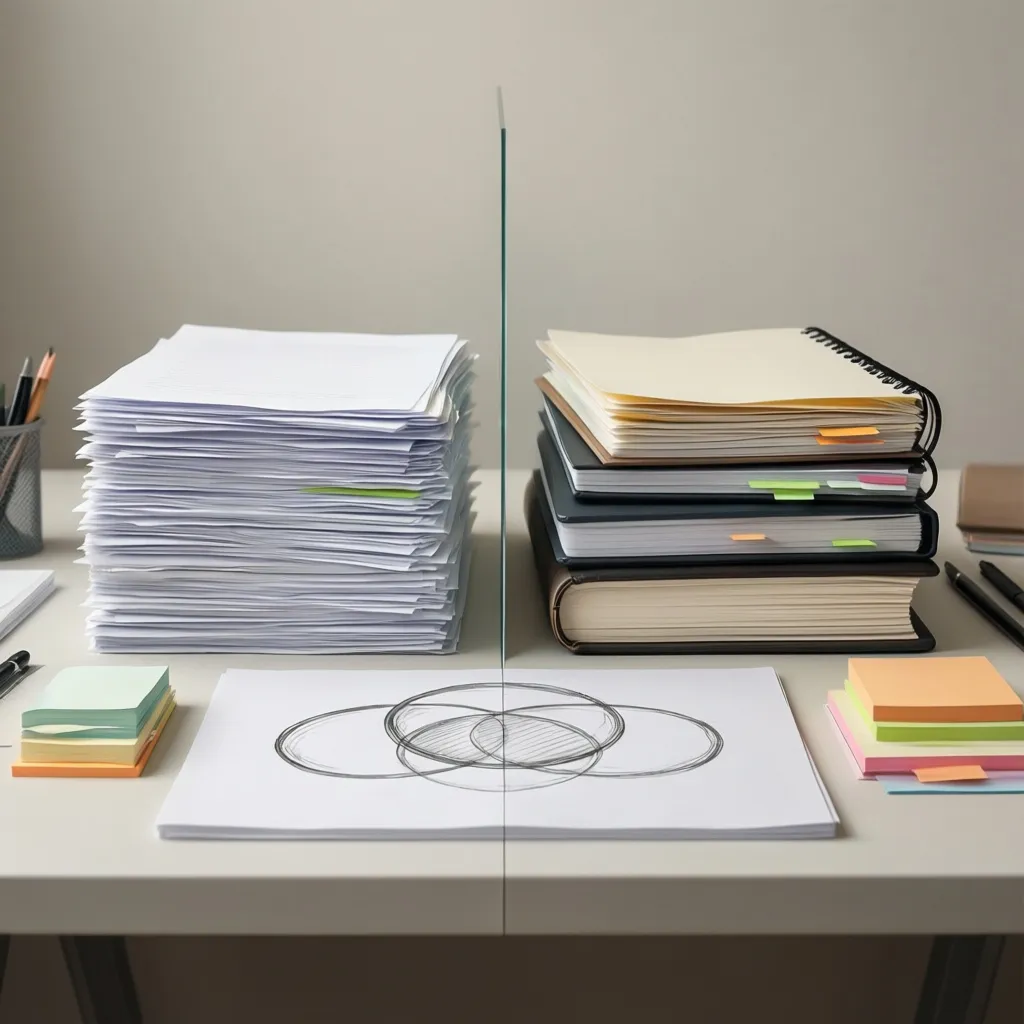
How to Structure a Compare-and-Contrast Essay Beyond the Basics

How to Structure a Compare-and-Contrast Essay Beyond the Basics

Start with your thesis that names the two subjects and states the single key insight you want readers to take away. Then decide between block or point-by-point order based on how much overlap your points have. Most writers get better results when they mix both: open with a short block paragraph on each subject, then switch to point-by-point for the rest of the body.

Build the Body with Clear Moves

Follow these four steps to keep the essay focused and easy to follow.

  1. Write one paragraph that sets the scene for subject A only. Keep it to three or four sentences so it does not drift into comparison yet.
  2. Write the matching paragraph for subject B. Use the same order of details you chose for A so readers can track the contrast without extra work.
  3. Switch to point-by-point paragraphs. Each new paragraph now handles one shared category: cost, time demands, social effects, or whatever fits your thesis.
  4. End every point-by-point paragraph with a one-sentence bridge that reminds readers of your main insight before you move to the next category.

Here is how the pattern looks in practice for an essay on remote work versus office work.

Paragraph focus Content example
Scene for remote Employees set their own hours and avoid a commute.
Scene for office Teams meet face-to-face at fixed times and share the same space.
Point 1: collaboration Remote teams rely on scheduled video calls while office teams solve problems in the moment during hallway talks.
Point 2: focus time Remote workers gain long stretches without interruption, yet office workers often lose that same stretch to drop-in requests.

Check your draft against this short list before you stop revising.

  • Thesis still matches the order you used in the body
  • Each point-by-point paragraph names both subjects in the first sentence
  • Transitions repeat one key word from the thesis instead of generic phrases like “on the other hand”
  • Final body paragraph returns to the insight you stated at the start

Smart Source Evaluation: How to Spot CRAAP and Avoid Bad Citations

Smart Source Evaluation: How to Spot CRAAP and Avoid Bad Citations

You open a search result and need to decide fast whether it belongs in your project. Run the CRAAP test on every source before you pull a quote or add it to your reference list.

Run the CRAAP Test in Five Steps

  1. Currency: Check the publication or update date. A 2014 article on TikTok algorithms fails here when your paper covers 2023 platform changes.
  2. Relevance: Read the abstract or first two paragraphs. Does the main claim actually match your research angle, or did the title pull you in under false pretenses?
  3. Authority: Look for the author’s name, credentials, and affiliation. A Medium post by an unnamed “researcher” carries less weight than a paper from a named professor at a known university.
  4. Accuracy: Scan for citations or data sources inside the piece. If claims sit without links or references, open a second tab and verify one key fact.
  5. Purpose: Ask why the page exists. A .com site selling supplements that also posts “studies” on vitamins usually has a sales goal first.

Check Citations with a Quick Table

Source type Red flag Next move
Blog post No date or author Search the claim on Google Scholar
News article Only one anonymous source Find the original study it cites
Website Statistics without links Trace the number to its origin report

Keep a short checklist on your screen while you draft: date present, author named, main claim supported, and purpose matches my needs. When any box stays empty, skip the citation and move to the next result.

Building a Student Routine That Protects Your Grades and Your Mental Health

Building a Student Routine That Protects Your Grades and Your Mental Health

Start by locking in consistent sleep and two fixed study blocks each weekday. This base keeps most students from falling behind while leaving room for rest.

Pick a bedtime you can hit six nights out of seven. Set an alarm for the same time every morning, even on lighter days. When sleep stays steady, focus improves and small mistakes drop.

Build your day in blocks

Divide study time into 50-minute sessions followed by a 10-minute break. Use the break for water, a stretch, or stepping outside.

  1. Choose two subjects that need the most attention that week. Put the harder one first.
  2. Block the first session right after your morning class or coffee. Block the second between 4 and 6 p.m.
  3. Track completion on a simple list: finished, partial, or skipped. Review the list every Sunday night for five minutes.

Here is one workable weekday example:

Time Activity
7:00 a.m. Wake, quick breakfast, 10-minute walk
9:00-9:50 a.m. Study block one (math notes and problems)
10:00 a.m. Class or review
4:00-4:50 p.m. Study block two (reading or lab prep)
5:00 p.m. Meal and 30-minute no-screen break
10:30 p.m. Wind down and lights out

Keep one evening free of new work. Use it for laundry, a call home, or an early night if you are tired. Students who protect one unscheduled night report fewer panic nights before tests.

Check your energy each Friday. If a block keeps getting skipped, move it to a different hour rather than adding more time. Small shifts beat big overhauls.

Editing Your Own Draft: A Step-by-Step Method for Catching Hidden Mistakes

Editing Your Own Draft: A Step-by-Step Method for Catching Hidden Mistakes

You catch more errors when the draft sits for at least a few hours. Come back to it when the sentences no longer feel fresh in your head.

Prepare Before You Start

Open the file and make two quick changes so the text looks different to your eye.

  • Switch the font to something you rarely use, like Georgia if you wrote in Arial.
  • Print the pages if you normally edit on screen. Hold a pen while you read.

Work Through These Checks in Order

  1. Read the whole draft out loud at normal speed. Circle every place you pause or have to reread.
  2. Go back to each circled spot and ask what the sentence actually says. Cut or reword anything that wanders, such as a sales paragraph that suddenly lists meeting times with no link.
  3. Check paragraph breaks. If one block holds two separate ideas, split it. For example, separate “We hit the revenue target” from the next thought about hiring plans.
  4. Scan for repeated words or phrases on the same page. Replace the second one with a plain alternative if it still fits.
  5. Read the first and last sentence of each section. Make sure they connect without extra explanation.
Quick Check Before After
Transition Revenue grew. We added two reps. Revenue grew because we added two reps.
Drift The campaign worked. Also, the coffee machine broke. The campaign worked. We later fixed the coffee machine in a separate ticket.

What to Do When You Disagree With Your Own Argument Mid-Essay

What to Do When You Disagree With Your Own Argument Mid-Essay

You hit a point where the evidence no longer lines up with the claim you set out to defend. Stop drafting and treat the mismatch as new information rather than a failure.

Notice the mismatch while it is still small

Most writers feel the shift in one of three places: a source contradicts an earlier point, a personal example undercuts the thesis, or a counterargument starts to feel stronger than the main line. Write the conflicting sentence down exactly as it sits. Do not revise yet.

  • Example: Your draft claims remote work always raises output. You then quote a study showing it only helps individual contributors, not managers who need real-time oversight.
  • Example: You planned to argue stricter gun laws reduce violence, but a paragraph on enforcement costs now makes you doubt the net benefit.

Decide whether to pivot or narrow

Compare the original claim against the new material in one short table.

Original claim New evidence or doubt Action
Remote work always boosts output Only helps non-manager roles Narrow thesis to non-manager roles
Stricter laws cut violence Enforcement costs may outweigh gains Pivot to a cost-benefit frame

Choose the route that keeps most of your existing paragraphs usable. Full reversal usually costs more time than refinement.

Revise the thesis and first paragraph first

  1. Replace the old thesis sentence with one that reflects the adjustment.
  2. Scan the next two paragraphs and cross out or qualify any sentences that no longer support the new claim.
  3. Insert one transitional sentence that names the change in direction, such as: “The productivity gain appears limited to roles without heavy coordination needs.”

Run a quick consistency pass

Read the revised sections aloud. Mark every sentence that still assumes the old stance. Fix those before you add new material. When the body paragraphs no longer fight the thesis, resume drafting from the point where you stopped.

MLA vs. APA vs. Chicago: A Cheat Sheet for the Perplexed Student

MLA vs. APA vs. Chicago: A Cheat Sheet for the Perplexed Student

If your assignment lists a style but you need the quick differences, start with the table below. Most students only need to know three things: field, citation format, and page layout.

Which Style Fits Your Paper?

Style Common in In-text citation Bibliography name Page numbers
MLA Literature, languages (Smith 42) Works Cited Top right with last name
APA Psychology, education, sciences (Smith, 2020) References Top right only
Chicago History, fine arts Footnotes or (Smith 2020, 42) Bibliography Bottom center or top right

Check your syllabus first. If the prompt says “social sciences” or includes a year in the citation example, lean toward APA. Literature classes almost always want MLA.

Sample Citations You Can Copy

Book with one author:

  • MLA: Smith, John. The Study Guide. Norton, 2020.
  • APA: Smith, J. (2020). The study guide. Norton.
  • Chicago: Smith, John. The Study Guide. New York: Norton, 2020.

Journal article:

  • MLA: Smith, John. “Student Stress.” College Journal, vol. 15, no. 2, 2020, pp. 45-60.
  • APA: Smith, J. (2020). Student stress. College Journal, 15(2), 45-60.
  • Chicago: Smith, John. “Student Stress.” College Journal 15, no. 2 (2020): 45-60.

Work through your references list once, then run a quick check: MLA uses sentence-style titles on the Works Cited page, APA capitalizes only the first word and proper nouns, and Chicago keeps headline style. That single difference catches most mix-ups.

How to Write a Thesis Statement That Actually Makes an Argument

How to Write a Thesis Statement That Actually Makes an Argument

A thesis that argues takes one side on a debatable point and gives readers a reason to care. Start by naming your exact claim in one sentence, then test whether someone could reasonably push back.

Pin down one clear claim first

Pick a narrow topic and state what you believe about it. Skip broad phrases like “social media affects people.” Instead name the effect and who it hits.

  • Weak: Remote work changes productivity.
  • Strong: Remote work raises output for software teams but lowers it for sales roles that rely on quick in-person closes.

Build in a reason readers can challenge

Add the “because” part so the statement invites disagreement. Without it, you only have a topic sentence.

  • Weak: Many students struggle with debt.
  • Strong: Income-driven repayment plans keep recent graduates in debt longer because they stretch payments over twenty years without addressing rising tuition costs.

Run it through this four-item check

  1. Does it take a side someone could argue against?
  2. Can you point to specific evidence in the next paragraph?
  3. Does it name who or what is affected?
  4. Is it one sentence you could defend in five minutes?

If any item fails, rewrite until every box is checked.

Watch the fixes on real drafts

Original Revised
Climate change is bad for farming. California almond growers lose 18 percent of their yield during multi-year droughts because current irrigation rules block groundwater banking.
Exercise helps mental health. Office workers who take a 30-minute walk at lunch report 25 percent fewer anxiety symptoms than those who stay at their desks, according to a 2023 study of 400 employees.