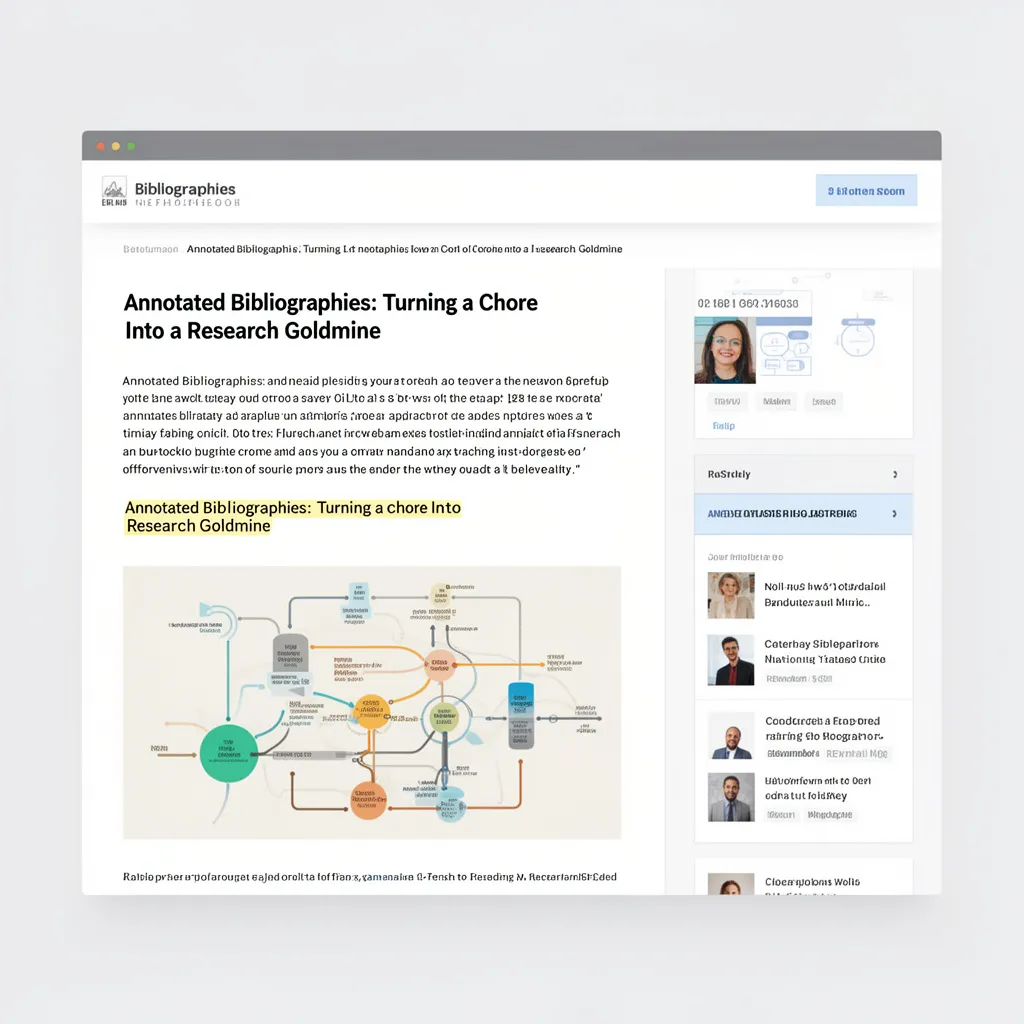
Annotated Bibliographies: Turning a Chore Into a Research Goldmine

Annotated Bibliographies: Turning a Chore Into a Research Goldmine

An annotated bibliography does more than list sources. It forces you to record what each source actually says and how you plan to use it, which cuts down on rereading later when you draft.

Start with the sources you already pulled for your current project. Pick five to start. The goal is a short note for each that you can scan in under two minutes next week.

Build the list in four passes

  1. Write the full citation in the style your field uses.
  2. Summarize the main claim in one sentence using the author’s own terms.
  3. Note the method or evidence type in a second sentence.
  4. Add one line on how this piece connects to your question or to another source you have.

Keep each annotation under 120 words. Longer notes become hard to scan.

Element Example (remote-work study)
Citation Smith, J. (2022). Remote teams and output. Journal of Work Research, 14(3), 45-67.
Summary Smith tracked 180 employees across six companies and found that output stayed flat when meetings dropped below four per week.
Method Used weekly self-reports and server log data over three months.
Use note I can cite this to counter the claim that all remote work lowers productivity; it also pairs with the 2023 Lee study on meeting load.

Review your finished list with this quick check:

  • Can I find the right source without rereading the full text?
  • Does each note show a clear link to my research question?
  • Are the connections between sources visible?

When you hit that point the bibliography stops feeling like extra work and starts acting as your working outline.

Synthesis Essay Writing: Weaving Sources Into a Single, Coherent Voice

Synthesis Essay Writing: Weaving Sources Into a Single, Coherent Voice

A synthesis essay pulls together points from several sources to support one main claim. You shape the material so the reader hears your voice first and the sources second.

Set Up a Strong Thesis

Read every source once, then decide what single idea they all help you prove. Write that idea as a full sentence before you outline anything else.

  1. List the main claim each source makes in one line.
  2. Circle the points that overlap or clash.
  3. Turn the overlap or clash into your thesis sentence.

Example: Three articles on remote work show higher output but rising isolation. Your thesis might read: “Remote work boosts short-term productivity yet creates long-term isolation that companies must address with new team practices.”

Merge the Material Smoothly

Place sources where they advance your point instead of letting them lead. Introduce each one with a short signal that shows why it matters right there.

  • Use paraphrase for background facts so the paragraph keeps moving.
  • Save direct quotes for sharp claims or striking wording.
  • Follow every source reference with one sentence that explains how it supports your thesis.
Method When to use Quick example
Paraphrase General data or repeated ideas A 2023 Stanford study found output rose 13 percent when teams worked from home.
Summary Whole argument in one source Author B argues isolation grows after six months away from the office.
Quote Exact wording carries weight Manager C calls the office “the only place real mentoring happens.”

Keep One Consistent Tone

Check every paragraph for sudden shifts in language. Replace any source wording that sounds more formal or casual than your own sentences.

Read the draft out loud. If a sentence sounds like it belongs to someone else, rewrite it in your own words while keeping the fact.

End each body paragraph by linking the source detail back to your thesis instead of moving straight to the next source.

What to Do When You Disagree With Your Own Argument Mid-Essay

What to Do When You Disagree With Your Own Argument Mid-Essay

You hit a point where the evidence no longer lines up with the claim you set out to defend. Stop drafting and treat the mismatch as new information rather than a failure.

Notice the mismatch while it is still small

Most writers feel the shift in one of three places: a source contradicts an earlier point, a personal example undercuts the thesis, or a counterargument starts to feel stronger than the main line. Write the conflicting sentence down exactly as it sits. Do not revise yet.

  • Example: Your draft claims remote work always raises output. You then quote a study showing it only helps individual contributors, not managers who need real-time oversight.
  • Example: You planned to argue stricter gun laws reduce violence, but a paragraph on enforcement costs now makes you doubt the net benefit.

Decide whether to pivot or narrow

Compare the original claim against the new material in one short table.

Original claim New evidence or doubt Action
Remote work always boosts output Only helps non-manager roles Narrow thesis to non-manager roles
Stricter laws cut violence Enforcement costs may outweigh gains Pivot to a cost-benefit frame

Choose the route that keeps most of your existing paragraphs usable. Full reversal usually costs more time than refinement.

Revise the thesis and first paragraph first

  1. Replace the old thesis sentence with one that reflects the adjustment.
  2. Scan the next two paragraphs and cross out or qualify any sentences that no longer support the new claim.
  3. Insert one transitional sentence that names the change in direction, such as: “The productivity gain appears limited to roles without heavy coordination needs.”

Run a quick consistency pass

Read the revised sections aloud. Mark every sentence that still assumes the old stance. Fix those before you add new material. When the body paragraphs no longer fight the thesis, resume drafting from the point where you stopped.